Hyperlocal, community-owned air monitoring
The WOAQ monitoring network is a community network of air quality sensors that measured West Oakland’s air from June 2024 to August 2025. The data from these sensors will help us advocate for stronger environmental policies and enforcement by telling a detailed story of our neighborhood’s exposure to air pollution.
Now, our partners at Spheros are analyzing the data to uncover the links between road dust (tiny pieces of brakes and tires that become airborne particulate pollution) and street sweeping. Does street sweeping improve air quality–or could it actually make it worse? The connection’s never been studied, and the results could give us new insights to tackle one of the fastest growing sources of air pollution in West Oakland.
Jump to: About the project • What we’re measuring • Project timeline
Hyperlocal measurement tells a more complete story
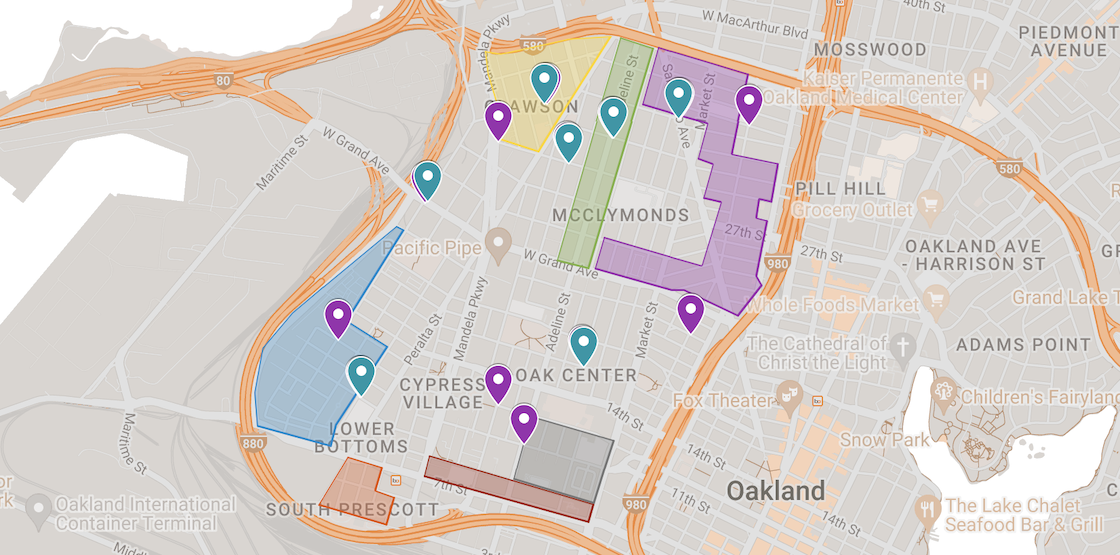
For years, there was only a single sensor in West Oakland, placed high above the neighborhood where it could not pick up detailed changes in the air that residents were breathing at ground level. Since 2008, WOEIP has partnered with researchers and technology companies to develop groundbreaking, hyperlocal maps that tell a more complete story about the sources of air pollution in our neighborhood, and who is most impacted from block to block.
Using this data, WOEIP helps visualize for policy makers what the community already knows: air pollution and its risks are unevenly distributed, and historically marginalized communities bear the burden.
Advanced technology in the community’s hands
We installed air quality sensors throughout West Oakland, focusing on West Oakland’s air quality impact zones. These are neighborhoods that experience higher levels of air pollution exposure and health risks, according to the West Oakland Community Action Plan.
What did the sensors measure?
The WOAQ monitoring network used three different types of air sensors that allowed us to capture a variety of dangerous pollutants. These include black carbon (BC), particulate matter (PM2.5), and more. These pollutants cause serious health issues, including asthma and other respiratory illnesses, heart disease, and increased cancer and mortality risks.
Black carbon, metals and dust
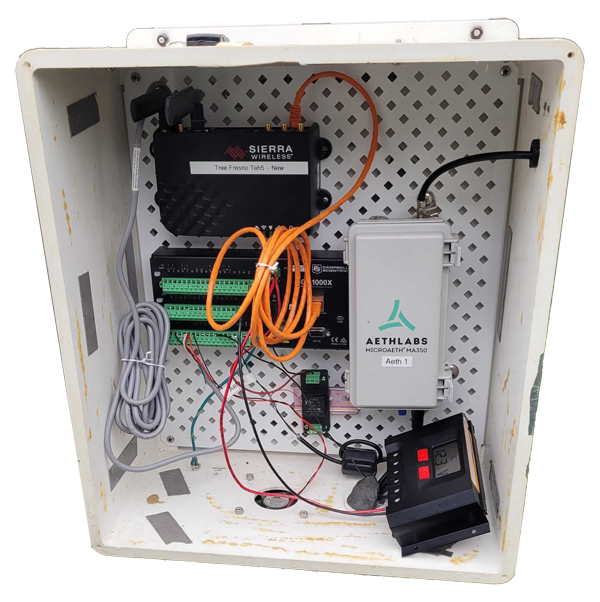
This dual-sensor combination measures black carbon (BC), which primarily comes from diesel exhaust, as well as toxic metals and dust. We currently have 7 combo sensors installed in the WOAQ monitoring network, and plan to install several more.
Fine particulate matter (PM2.5)
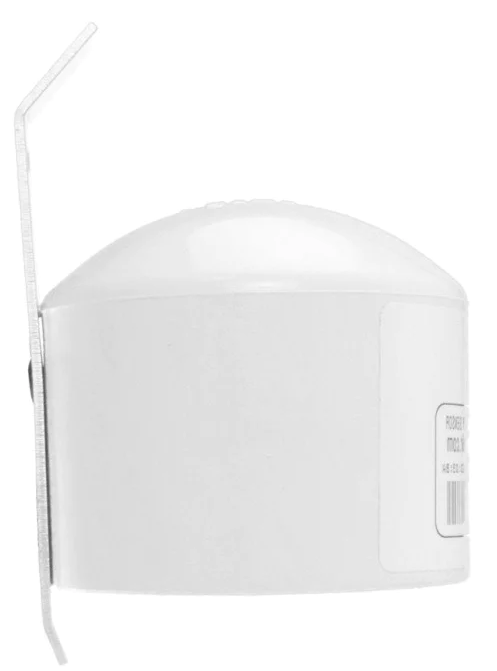
For participants with location constraints, we use Purple Air sensors to measure fine particulate matter (PM2.5). PM2.5 comes from dust, smoke, vehicle exhaust, and other sources. We currently have 14 Purple Air sensors installed in the WOAQ monitoring network, and plan to install another half dozen or so.
This project is funded by a supplemental environmental grant from:

WOEIP is pleased to work with Sonoma Technology as our technical partner.
